
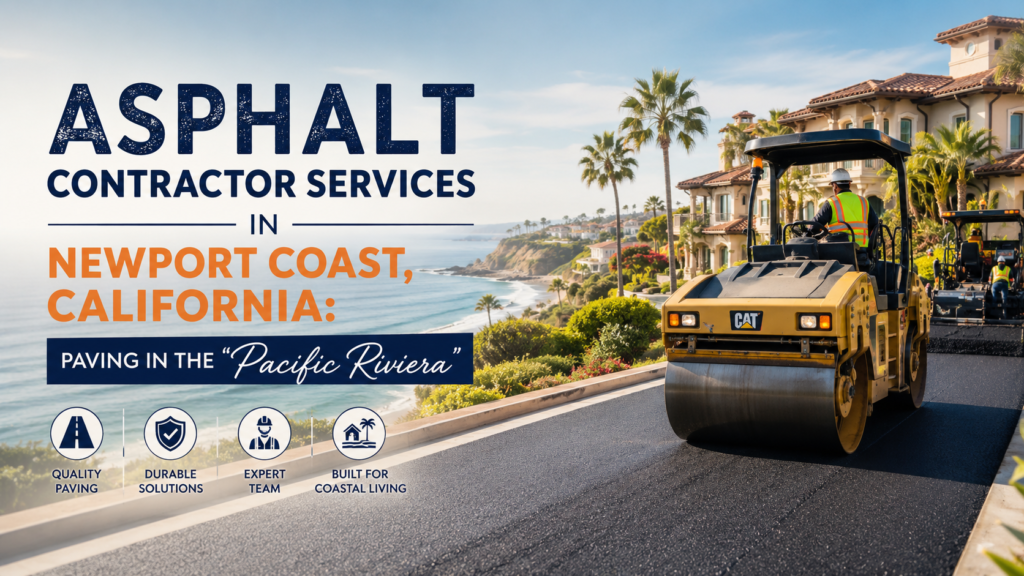
Newport Coast is one of Southern California most exclusive residential communities, an affluent enclave perched atop coastal bluffs and hillsides at the southern end of Newport Beach, just north of Laguna Beach. Often called the “Pacific Riviera,” the community spans roughly 9,432 acres, of which approximately 75 percent is preserved as open space and golf courses anchored by the Pelican Hill Resort, its Tom Fazio-designed golf courses, and the adjacent Crystal Cove State Park. Master-planned by the Irvine Company on the hillsides and bluffs above the Pacific, Newport Coast encompasses gated enclaves including Crystal Cove, the Pelican family of communities (Pelican Hill, Pelican Crest, Pelican Ridge, and Pelican Point), Ocean Heights, Pacific Ridge, and Newport Ridge, all defined by Mediterranean-influenced architecture, view-corridor planning, and an extraordinary standard of property maintenance. For Asphalt Contractor Newport Coast represents one of the most technically demanding and quality-exacting markets in coastal Orange County.
The Hillside and Bluff Terrain of Newport Coast
Newport Coast sits within the San Joaquin Hills, and its master-planned neighborhoods are built across coastal hillsides and bluffs with significant elevation change. This terrain shapes nearly every aspect of asphalt paving work in the community:
- Steep, winding access roads: Many of the gated enclaves within Newport Coast are reached via roads that climb significantly from Pacific Coast Highway or the 73 Freeway corridor to ridge-top and bluff-top homesites. Driveways within these communities frequently navigate substantial grade changes over short distances.
- Slope stability and geotechnical considerations: Hillside and bluff-adjacent properties throughout Newport Coast may require specialized geotechnical evaluation for any significant grading or paving work, particularly where slope stability, drainage, or proximity to coastal bluff edges is a factor. Property owners undertaking major paving or driveway projects on hillside parcels should coordinate any necessary geotechnical review with the appropriate civil engineering professionals before work begins.
- Drainage engineering on slopes: Properly designed drainage is essential on every Newport Coast driveway and access road. Water that is not correctly managed on sloped paved surfaces can concentrate, erode landscaping, or create drainage conflicts with neighboring properties a meaningful concern in a community where landscape presentation and property boundaries are taken seriously.
Coastal Climate and Asphalt Performance in Newport Coast
Sitting directly above the Pacific at elevation, Newport Coast experiences the full combination of Southern California coastal paving stressors:
- Intense UV exposure: The community elevated, largely open hillside terrain means many paved surfaces receive direct, unobstructed sun exposure throughout the day. UV radiation oxidizes the asphalt binder, gradually hardening it and leading to surface cracking and raveling if not protected through regular sealcoating.
- Salt air: Proximity to the ocean means salt aerosols are continuously deposited on paved surfaces throughout the community, accelerating binder oxidation and contributing to surface deterioration over time.
- Marine layer moisture: The coastal marine layer that regularly affects this stretch of the Orange County coast introduces consistent moisture exposure, particularly during late spring and summer mornings.
Given this combination, sealcoating on an 18 to 24 month cycle somewhat more frequent than the 2 to 3 year interval common in inland Orange County communities is generally appropriate for Newport Coast properties seeking to maintain both pavement performance and the polished appearance expected throughout the community.
Residential Driveway Paving for Newport Coast Estates
The custom and semi-custom homes throughout Newport Coast gated enclaves ranging from substantial estates in Pelican Crest and Crystal Cove to the villa-style residences common in communities like Ocean Heights and Pacific Ridge feature driveways that are integral to the property overall architectural presentation. Quality driveway paving in this market requires:
- Appropriate base depth for hillside conditions: A minimum 4 inch Class II aggregate base is standard, with greater depth often warranted on steeper grades or where sub-grade conditions are less favorable.
- Caltrans-specified asphalt mix appropriate to coastal Orange County temperature ranges, ensuring the binder maintains flexibility through the community mild winters while resisting softening during warm summer afternoons.
- Precise edge detailing and finish quality consistent with the architectural standards of custom hillside estates.
- Drainage design integrated with the property broader landscape and hardscape plan, directing water appropriately given the significant grade changes common throughout the community.
HOA and Architectural Review Requirements
Virtually every neighborhood within Newport Coast operates under guard-gated homeowners association governance with detailed architectural guidelines and CC&Rs. Before any driveway paving, resurfacing, or related exterior work, property owners should confirm requirements with their specific community sub-association which may govern acceptable paving materials, finishes, colors, and the process for submitting work for architectural approval. Many Newport Coast HOAs also have specific requirements regarding vendor access, work hours, and notification procedures for contractors entering guard-gated communities, which experienced local asphalt contractors are familiar with navigating.
Coastal Zone Considerations
Significant portions of Newport Coast fall within the California Coastal Zone, meaning that certain paving and grading projects particularly those involving substantial site work, drainage modifications, or work near coastal bluffs may require review coordination with the California Coastal Commission in addition to standard City of Newport Beach permitting. Property owners planning major paving or hardscape projects on bluff-adjacent or environmentally sensitive parcels within Newport Coast should confirm applicable coastal zone requirements early in their planning process.
California Contractor Licensing
All asphalt contractors performing work in Newport Coast must hold a current California Contractors State License Board (CSLB) license, with Class C-12 (Earthwork and Paving) being the applicable classification for asphalt paving and maintenance work. Given the premium nature of properties throughout this community, verifying current CSLB license status, bond, and insurance coverage before engaging any contractor is a reasonable and standard precaution for Newport Coast property owners.
Conclusion
Asphalt contractor services in Newport Coast operate at the intersection of demanding hillside terrain, intensive coastal climate exposure, and some of the highest property maintenance standards in Southern California. Property owners throughout this master-planned bluff-top community who understand the specific drainage and slope considerations of hillside paving, commit to the more frequent sealcoating schedule that coastal UV and salt exposure demand, and coordinate appropriately with HOA architectural review and coastal zone requirements protect both their pavement investment and the exceptional presentation standard that defines the Newport Coast lifestyle.